
Every February and August, most Australian listed companies reveal their profit results and guide how they expect their business to perform in the upcoming year. While we regularly meet with companies between reporting periods to gauge their business performance, the reporting season offers investors a detailed, externally audited view of the company's financials.
The recently concluded February 2026 company reporting period highlighted how volatile earnings season can be when the market is at all-time highs, with investors nervous about rising geopolitical tensions. The dominant themes of the February reporting season have been that Australian consumers continue to spend despite rate hikes, that Trump's tariffs have had a negligible impact, that bank profits are high, and that most companies presented a solid economic outlook.
Overall, February 2026 showed that Australian corporates are in better health than expected, with profits showing minimal negative impact from geopolitical events such as Trump's ever-changing trade policies. This saw the ASX 200 hit an all-time high, led by the large miners and banks. This week's piece looks at the key themes from the reporting season that fared last week, the best and worst results and how the Allied Wealth Direct Equities Portfolio performed over the month.
This February reporting season continued the volatility we saw in 2025. The average intraday share price move was 8% among the stocks that reported, with 12 large-cap companies recording share price moves of more than 10% on results day. This is very unusual, as the fortunes of the largest Australian companies rarely change significantly in the short term, with no company revealing a profit result warranting changes of billions to its valuation. Cochlear's first-half profit was $7M below expectations and only 10% growth for 2026; however, this saw $3.5 billion wiped off the hearing device company's market capitalisation on the day they released their results.
More confusing was the market reaction to JB Hi-Fi's result, which initially rose 4%, then fell 4% (a swing of 8%) before finishing up 7.5% at 4 pm, moves that saw us, as shareholders, tearing our hair out. Apparently, the AI bots had trouble interpreting the profit results from the electrical goods retailer. We see this as the result of the increasing influence of momentum trading driven by computerised programs immediately after company results are released.
Retailing has been a mixed bag over the last 6-12 months, with consumers becoming more value-conscious, making discount and promotional periods even more important for sales growth. Discount retailer JB Hi-Fi saw sales increase by 7% over the period, driven by higher sales during Black Friday and Boxing Day. The opposite could be said of Domino's Pizza, which saw Australian sales fall by 8% as it stepped away from heavy discounts and promotional periods.
Wesfarmers similarly announced that it is repositioning how Officeworks approaches the market and its value proposition for customers. Officeworks is currently undergoing a transformation program to move to a lower-cost operating model, which will support lower product pricing and enable it to compete more effectively during promotional periods. Wesfarmers' other key retail divisions, Bunnings and Kmart, have been the lowest-cost operators in their respective fields of hardware and discount department store retail for some time, which has enabled them to continue taking market share and increasing profits. The message for investors is to invest in the lowest-cost operator.
Domestically focused companies benefited from Australia's comparatively resilient Economy, supported by a strong labour market and steady population growth. Without exposure to slowing international economies, geopolitics, and foreign exchange swings, these domestic companies were able to deliver resilient, stable earnings.
Since the start of the year, we have seen an increase in negative international geopolitical news, including new tariffs, actual wars, presidential captures, and plans to take over Greenland. All of these have caused negative moves on the ASX but ultimately had minimal impact on profits.
Higher copper prices played a major role in lifting earnings for major ASX 200 miners, with BHP delivering one of the standout results of the season. The company reported that copper earnings surpassed iron ore for the first time in its history, a shift directly linked to the strong rally in copper prices driven by electrification demand and tight global supply. This surge helped BHP post a stronger-than-expected half-year result, contributing to a broader wave of profit upgrades across the resources sector. Other diversified miners such as South32 also benefited from the uplift in base and precious metal prices, reinforcing copper's growing importance as a profit engine.
Gold producers also enjoyed a stronger earnings backdrop, driven by rising gold prices, which supported safe-haven flows amid global volatility. Northern Star is one of the companies benefiting from the commodity-price tailwind, with higher realised gold prices helping lift margins and earnings. This strength in gold helped miners outperform the broader ASX 200 on several trading days, even as most other sectors were under pressure. The combination of elevated gold prices and surprisingly resilient production volumes positioned gold miners in a strong position heading into 2026.
Commonwealth Bank provides a good look through the Economy during reporting season, with Australia's largest bank holding over 17 million customer accounts. Consequently, the big banks' financial results and accompanying 174-page reporting suite give investors an insight into the health of the various sectors of the Economy. CBA showed minimal bad debts and rising dividends, but also that higher interest rates had differing impacts across their customer base. Discretionary spending decreased on average over the last year for customers aged 35+, while customers aged 35 and below increased spending from a low base last year.
The CBA result highlighted the underlying resilience of the Australian Economy despite stronger economic activity, inflation, and labour markets. The bank did highlight that stubbornly high inflation will likely see the cash rate increased twice over the year to 4.1%. These increases in the cash rate are unlikely to trigger a dramatic spike in bad debt, with most mortgage holders having rebuilt their savings buffer over the last 18 months.
Over the month, Lynas Rare Earth, Iluka Resources, NRW Holdings, PLS Group, and Tabcorp delivered the best results. These companies benefited from higher commodity prices and operational efficiencies.
Looking on the negative side of the ledger, Temple and Webster, Web Travel, Pro Medicus, Data #3, and ZIP reported results that were poorly received by the markets. The common themes amongst this group were underdelivering on growth when trading on a high P/E, and the prospect that AI could replicate their offerings for much lower cost.
Before the February 2026 reporting season, everyone understood that copper was becoming a more central part of BHP's earnings. Few expected copper to account for 51% of BHP's earnings. This increase in copper earnings was driven by a 32% increase in the copper price over the first half of 2025. This increase saw profits rise 34% to $12.3 billion, with the dividend rising 44% to US$0.73 per share. Even more unexpected was the entry into a long-term streaming agreement with Wheaton, in which Wheaton receives BHP's share of silver production from Antamina copper mine in Peru for US$4.3 billion. Unusually, the result of the season comes from a large company.
When a company reports a result, one of the first things we look at is the dividend paid, as this is the best indicator of a company's actual health. A company's board is unlikely to raise dividends if business conditions are worsening. Also, earnings per share can be restated later due to "accounting opinions" or financial shenanigans from the company's finance team. However, once dividends are paid into bank accounts, they cannot be reclaimed.
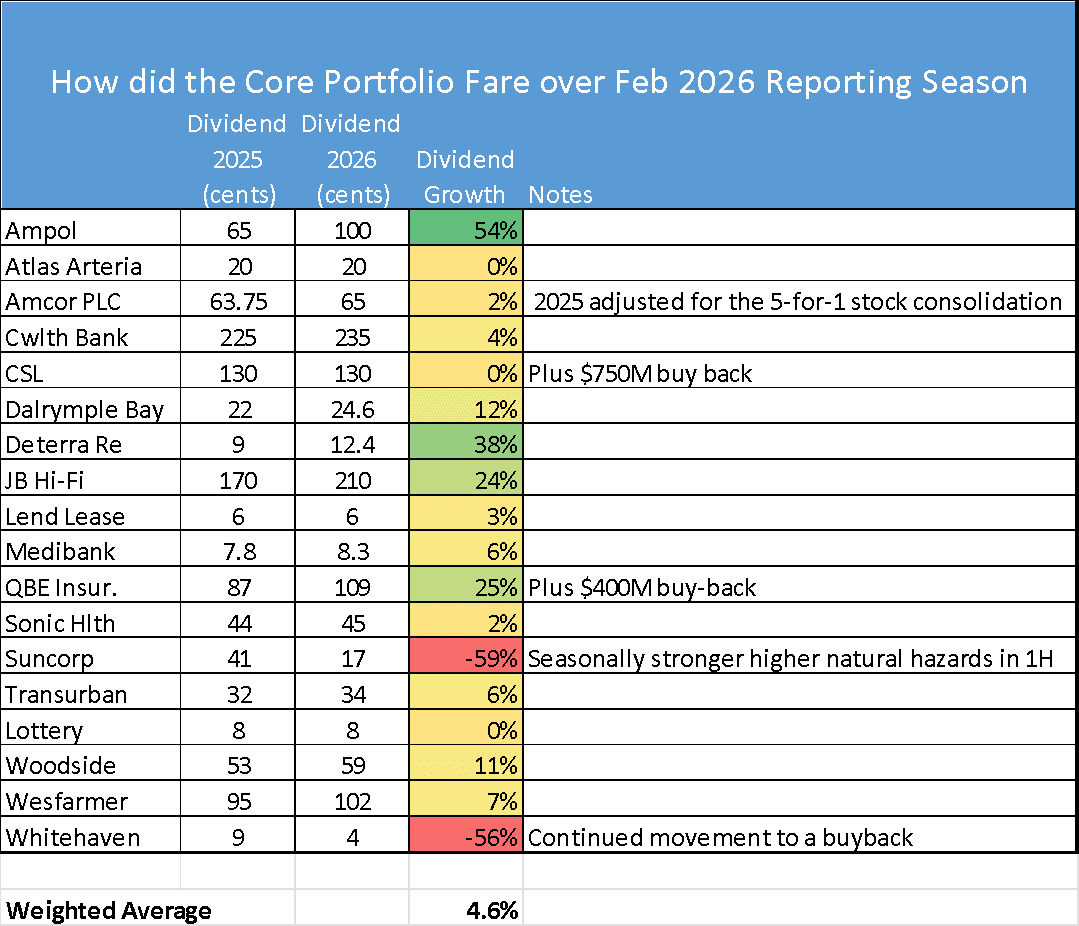
Source: Allied Wealth.
Using a weighted average across the Allied Wealth Direct Equities Portfolio, our investors' dividends will be +5% higher than in the previous period in 2025 and significantly ahead of inflation. We see that dividends are a better measure of a company's financial health than earnings per share. In the short term, the market is a voting machine that rewards popular companies; in the long term, it is a weighing machine that rewards companies that consistently pay increasing dividends to shareholders.