
Retirement is a significant life milestone that many look forward to finally achieving – after years of hard work retirement offers a reprieve where you can start spending your days exactly how you like! BUT proper financial planning is crucial when considering retirement to ensure that you have a comfortable and secure retirement.
Whether you're nearing retirement age or you’re just starting to get your ducks in a row for when that day comes, it's never too early to begin your retirement planning journey.
At Allied Wealth, we specialise in providing financial advice for would-be retirees, and we're here to help you navigate this exciting (and sometimes daunting) phase of your life.
With over 60 years of combined experience, we've gathered valuable insights into effective retirement planning. In this blog, we'll share our seven top tips to help you kickstart your retirement planning journey.
The first step in retirement planning is to clearly define your retirement goals – take some time to envision your ideal retirement lifestyle and what that looks like for you. Ask yourself: What do you want to do each day? Any activities you want to pursue? Where do you want to live? What do you envision as a day in your life during retirement?
Setting specific and achievable goals will provide you with a clear sense of direction for your financial planning. At Allied Wealth, we work closely with our clients to understand their unique aspirations and create customised retirement plans for every unique individual that aligns with their plan for retirement.
To plan effectively for retirement, you need to have a clear understanding of your current financial situation and the finances you need to retire comfortably. Calculate your current savings, assets, and debts as well as analyse your current income sources and various everyday life expenses.
This assessment will help you determine how much you need to save for retirement to live comfortably and how close you are to your financial goals. Our team at Allied Wealth can assist you in conducting a thorough financial review to identify any areas that may need some extra love.
Once you have assessed your current financial situation, it's time to embark on creating your retirement budget. A retirement budget will help you allocate your resources and funds to ensure that you have enough income to cover your expenses in retirement.
Consider factors such as housing, healthcare, travel, and any fun hobby activities you wish to partake in during your retirement. At Allied Wealth, we recommend a proactive approach to budgeting, to ensure that your retirement income aligns with your desired lifestyle.
At Allied Wealth, we believe in a proactive, discretionary, and personalised asset allocation approach. Diversifying your investments is a key component of this retirement strategy.
Spread your various investments across different asset classes, such as stocks, bonds, and real estate, to reduce risk and optimise your overall returns. Our experienced financial advisors can help you design an investment portfolio that suits your risk tolerance alongside your long-term financial retirement goals.
Maximising your retirement savings is crucial, and taking advantage of retirement accounts is a smart way to do so. In Australia, options like superannuation funds and self-managed superannuation funds (SMSFs) provide tax advantages and investment opportunities for budding retirees.
Our team at Allied Wealth can guide you in selecting the right retirement accounts and optimising your contributions to secure your financial future.
Retirement planning is not a one-time task – it's an ongoing process that changes frequently. Life circumstances, financial markets, and economic conditions can change, all of which may impact your retirement plan.
It's essential to review and adjust your plan regularly to stay on track. At Allied Wealth, we maintain an in-depth knowledge of our clients' financial environments, allowing us to be highly responsive and effective when adjustments are needed.
One of the most important tips for successful retirement planning is to seek professional financial advice. At Allied Wealth, we have a team of senior advisors with over 60 years of combined experience in looking after clients and their needs.
Our expertise allows you to benefit from ongoing advice at a transparent flat fee, with no extra costs or commissions. We provide ethical and independent financial advice for retirement planning, to ensure that your best interests are always at the forefront of our recommendations.
Retirement planning is a critical aspect of securing your dream financial future and ensuring you live the life you’ve always dreamed in retirement. At Allied Wealthwe are committed to helping you achieve your retirement goals with our proactive and personalised approach to financial advice for retirees and individuals looking to retire in the future.
Plan today with Allied Wealth, and secure tomorrow with ease, our dedicated team of senior advisors is here to support you every step of the way, ensuring that your retirement years are filled with financial security and peace of mind. Contact us today to start your retirement planning journey off on the right foot – it’s never too early to start planning for your future!
Asset Class and Economic Themes
In our last newsletter we highlighted a volatile market environment which has continued unabated. As the year has progressed, we have become resigned to the fact that volatility is here to stay. RBA cash rates are currently at 4.1% and this means that bonds once again produce yield. The impact of higher debt costs, combined with higher than target inflation prints, does introduce an increased level of future uncertainty – thus reflected in the volatile environment.
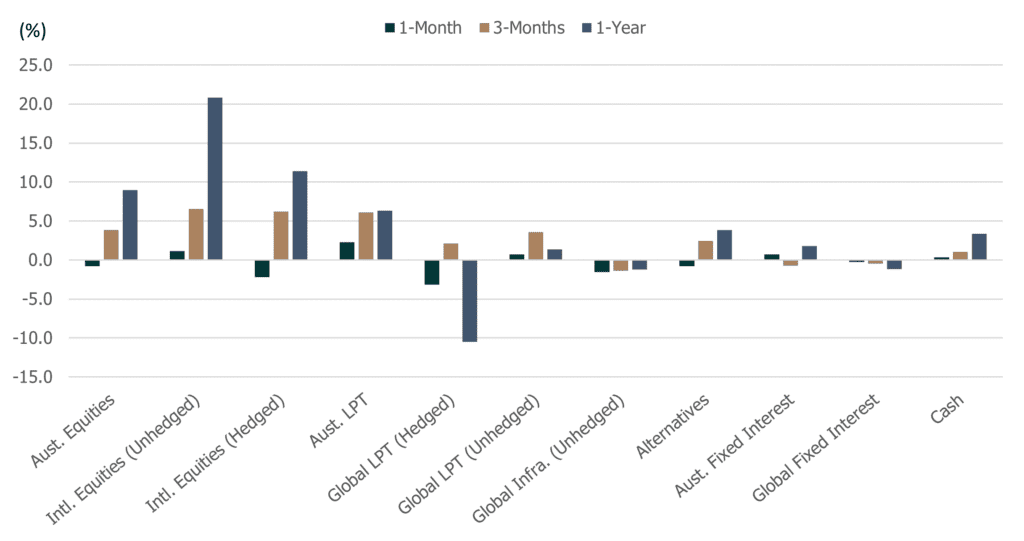
Whilst growth assets posted positive returns over the 3-month and 1-year periods, performance over the August month has been negative. The exception has been unhedged international equities which has benefitted from the depreciation of the Australian dollar, offsetting the negative equity returns.
Figure 1: Asset Class Performance as at 30 June 2023
Source: Allied Wealth, Morningstar.
Please note that asset allocation performance calculations have been conducted as of June 2023 and we will provide a further update to performance by the end of September 2023.
Portfolios currently maintain a marginally defensive asset allocation stance. As discussed in the last newsletter, the decision reflects a focus on risk management rather than profit maximisation. Whilst total return outcomes for clients are positive, our relative to SAA attribution indicates that this defensive position has detracted value over the June quarter as equity markets rallied.
Figure 2: Asset Allocation Performance as at 30 June 2023
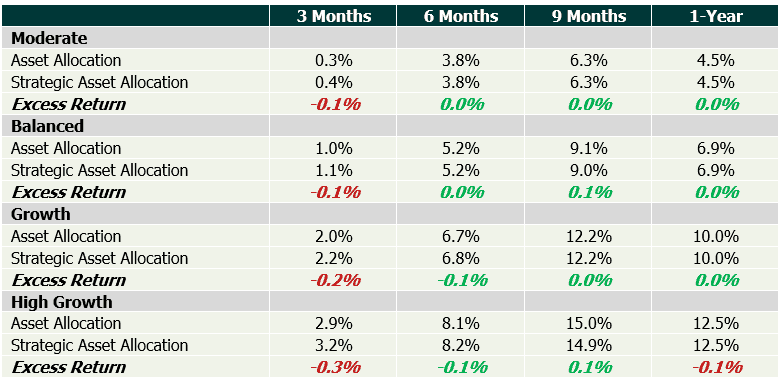
Source: Allied Wealth, Morningstar. Note: Returns are based on an asset allocation index returns which do not include manager and advice fees so actual portfolio returns will vary. The purpose is to determine if our tactical asset allocation decisions are adding value over the Strategic Asset Allocation for each model.
What is Our Current Investment Outlook?
At the time of writing, the Reserve Bank of Australia (RBA) cash rate stands at 4.1% p.a. and represents an increase in interest rates by a whopping 4% since May 2022. The impact of higher interest rates has been felt by consumers; more so on the lower-income end of the spectrum. Higher mortgage payments and material increase in rents have eaten into the excess savings accumulated through the Covid19 pandemic and resulted in negative disposable income.
Figure 2: RBA Measure of Australian Household Income and Consumption
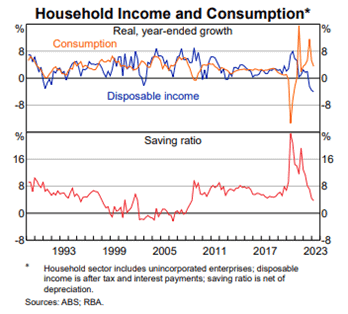
Obviously, this is not just a localised phenomenon. The same consumer impact is also observed in the United States (US). Despite tighter labour markets, wage growth has not outpaced the combined impact of higher inflation and mortgage rates.
Figure 3: Consumers Aggregate Personal Savings versus the Pre-Pandemic Trend
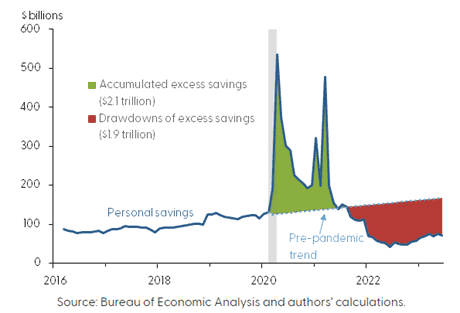
Source: Federal Reserve Bank of San Francisco
From an inflation management standpoint, the sharp interest rate hiking cycle saw inflation ease over the last 6 months. In Australia, inflation peaked at 8% in December 2022, but since moderated to 6% in June 2023. Since the last rate hike in June this year, the RBA remained on pause but left the door open to further interest rate hikes if required. At 6%, inflation remains materially above the 2% to 3% targeted by the RBA.
Across July and August, companies domestically and globally reported on Q2 2023 earnings. Data suggests that earnings to date have remained resilient, but the forward outlook has been revised downwards. Costs management remains problematic for companies particularly as it relates to labour, rent and energy prices. Profit margins so far have been retained by passing on costs to consumers, and this in turn has contributed to the above target inflation number.
Ironically, labour cost pressures faced by companies is the reason why consumers have been able to broadly absorb the increased costs of goods. Consumers domestically face increasing cost pressures which is exacerbated by a large number of low fixed rate mortgages rolling off in August (termed the mortgage cliff). Anecdotally we believe the low-income cohort of consumers are already affected. In the most recent earnings season, Woolworths and Coles reported the highest number of grocery theft experienced in recent history.
Our base case remains that inflationary pressure is likely to stay above the targeted rate. This may mean another hiking cycle at the beginning of 2024. Timing of the interest rate hikes may occur at the same time labour market softens and when the majority of consumers have drawn down their pandemic savings. This is likely to lead to lower growth going forward which will in turn weigh on equity valuations.
What is the Counter to Our Investment View?
Whilst we have an investment outlook which reflects a negative view on growth assets, discussions held at the investment committee also included scenarios which would run counter to our base investment thesis. Following our analysis, we believe there are a specific set of conditions that will need to be met for equities to grind higher.
The key condition is that inflation continues to moderate over the forward period and comes in below the 3% upper band without any additional interest rate hikes. Additionally labour markets will have to soften but with increased labour productivity (i.e. people work harder for same level of pay). These two in combination will allow corporate profit margins to grow and justify current equity market valuations.
Despite our negative outlook, we acknowledge that both regulators and central banks have done a fantastic job at steering the economy over the last 12-months. We continue to expect them to utilise all the tools at their disposal to ensure any market downside is not permanent or long lasting.
Investment Market Trends
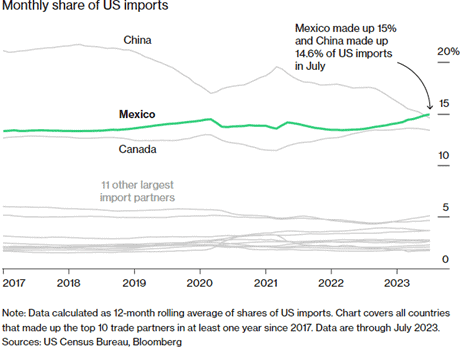
Outside of economic conditions, there have been two market themes that have captured our attention. Over the preceding quarters, we have written about how the geopolitical tension between US and China has resulted in a shift of factories and production away from China to US-friendly countries. We are finally seeing some concrete evidence to back this view. Trade data for the 12-months to July 2023 indicates that Mexico has now overtaken China as the largest exporters of goods to the US.
Figure 4: Mexican Exports to the US Finally Outpace China
Artificial Intelligence (aka. machine learning) has come a long way since its humble beginnings in 1956 when the first artificial intelligence (AI) program was presented at the Dartmouth Summer Research Project on Artificial Intelligence conference. Since then, we have seen substantial improvements to machine learning algorithms, data availability, computational power and costs of access such that machine learning models may be built and deployed by anyone with a personal computer and access to the internet. Thus, it is not surprising AI has taken over everything from creative endeavours to industrial manufacturing. Some machine learning models have even been deployed to support corporate decision making.
Even though we are very positive on the development of AI and its implications for humanity, we are concerned that AI has also become the marketing buzz word and the go-to panacea to resolve all our worldly ills. Take for example the claim that AI will solve global warming; whilst we can see how AI can help, ultimately a change in human behaviour will still be required to get there.
Selfishly, we are also getting a little tired of seeing AI slides in earning presentations promising the world. It would not be an exaggeration to say that 3 out of 4 earning presentations would include a slide dedicated to AI.
Investment Decisions and Strategy Implications
Coming back to our base investment thesis, given the confluence of events, we have made the decision to maintain a defensive stance across our portfolios. We believe there is stress building in the system despite the fantastic job done by regulators and central banks over the last 12-months. So far, the negative impact from the rise in interest rates has been broadly offset by substantial amounts of pandemic driven savings and tightness in labour markets – we do not believe this will last much longer. Despite the negative view, we are also monitoring the market for signs which are counter to our investment thesis. Emergence of a more positive macroeconomic environment may require a change in stance. From a risk management perspective, we remain comfortable with our current positions.
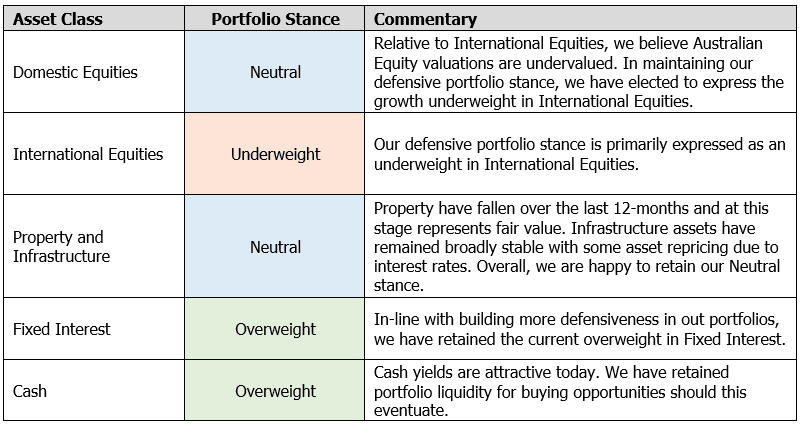
In-line with the outlook, the Investment Committee has decided to maintain an underweight growth assets in favour of an overweight to defensive assets. No asset allocation changes have been made.
Figure 5: Asset Class Summary and Portfolio Stance
Every investment decision is not undertaken lightly and is based on investment research, sized by our conviction. As with every decision we continue to monitor the market for signs of support or contradiction to our investment thesis.
Yours faithfully,
Allied Wealth Investment Committee
What sets Allied Wealth apart
Allied Wealth's core principles
You are welcome to pass on this commentary or our contact details to anyone whom you think would benefit from our services.

General advice warning
Disclosure
The information provided in and made available through this document does not constitute financial product advice. The information is of general nature only and does not take into account your individual objectives, financial situation or needs. It should not be used, relied upon, or treated as a substitute for specific professional advice.
We recommend that you obtain your own professional advice before making any decision in relation to your particular requirements or circumstances.
Allied Wealth Pty Ltd is a Corporate Authorised Representative of Allied Advice Pty Ltd for financial planning services. AFS Licence No. 528160
Episode details - 22 August 2023
Greg and Brendon Vade chat about the benefits advisers have experienced from having an investment committee and outline some of the challenges they have faced throughout their journey.
Our team discuss the challenges faced in dealing with an investment committee. Greg is a highly experienced independent advisor at Allied Wealth who can offer you investment advice that is the best possible solution for you.
Asset Class and Economic Themes
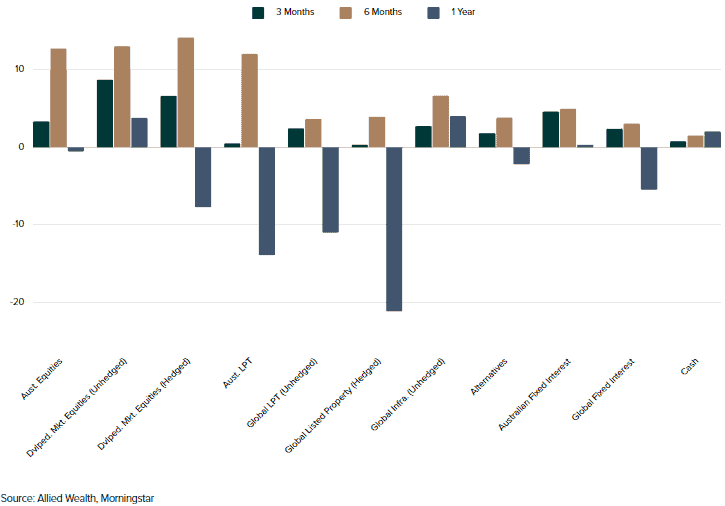
We hope we are not the only ones to feel a little confused by financial markets. Summarising the quarter, January started out with a strong equity market rally only to start falling in February; followed by a short-term banking crisis which unfolded in the first week of March but was resolved within 3 weeks. Despite the near miss, equity markets ended the quarter generally outperforming bonds.
Figure 1: Asset Class Performance as at 31 March 2023 Best financial advisor Sydney
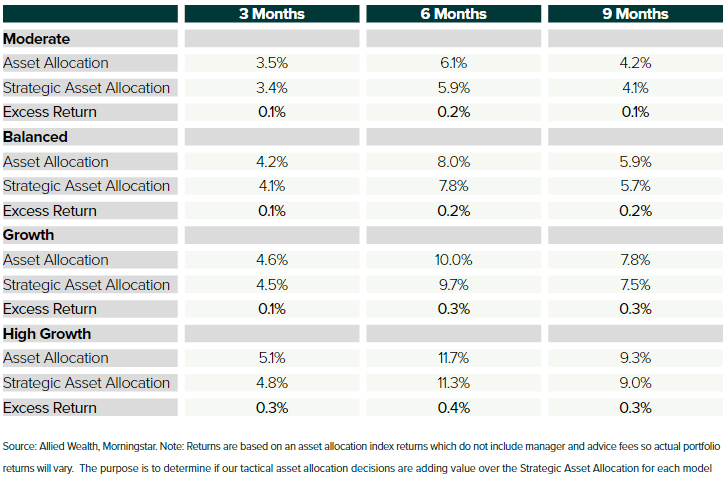
The asset allocation positions taken over the last 9 months have added value to portfolio outcomes. However, the cautious positioning has meant that excess returns relative to benchmark Strategic Asset Allocation (SAA) are marginal. Not unlike the experience over the previous quarters, all asset classes have been extremely volatile over the period – bond yields for example fell more than 1% in a day in response to the collapse of Silicon Valley Bank. Overall, we are pleased with the positive outcomes for clients.
Figure 2: Asset Allocation Performance as at 31 March 2023 Independent financial advisor
What is Our Current Investment Outlook?
In our prior quarterly newsletter, we highlighted the changing market environment and flagged an upside and a downside economic scenario tied to rising interest rates and tightening financial conditions.
Interestingly we saw a short-term banking crisis unfold in March which was met with quick action by regulators to stem the crisis. This culminated in the sale of Silicon Valley Bank in the US; and forced sale of Credit Suisse to UBS in Europe. Fast forward to today, markets have calmed down and the focus has once again shifted back to longer-term fundamentals. Despite the quick resolution, we think this is but a symptom of the broader pain the market is likely to experience going forward.
Reflecting on this discussion at our April Investment Committee, the debate this quarter centred around the possibility and probability of a hard recession. While a range of upside and downside market scenarios are possible, we think the probability of a downside scenario has increased. Simplistically we would quantify the probability of a hard economic landing as having increased from 45% to 60%.
Let us step through key thematic which has shaped our view.
The Dynamics of Inflation and Interest Rates
As we have seen over the 12-month period, interest rates have risen substantially. Raising interest rates is a function of central banks to try and moderate inflation and over the last 2 years, interest rates have trended materially above the desired target of 2-3% In-line with our expectations, historical data suggests that inflation in both US and Australia peaked in December 2022 but levels remain broadly elevated.
Figure 3: Australian Consumer Price Index as at 31 March 2023 Independent financial advice
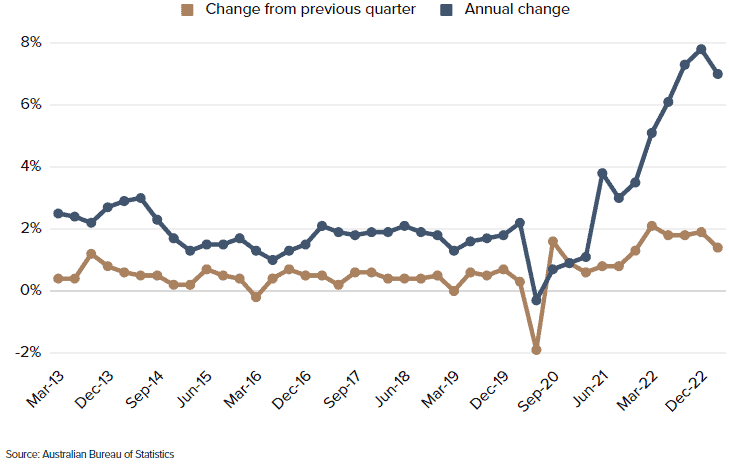
Future inflation prints are likely to continue lower due to base effects. However, we are concerned that the elevated level and sticky core inflation is likely to result in further interest rate hikes before the central banks pause. Any additional interest rate hikes are likely to put more pressure on corporate balance sheets and consumers alike going forward.
Equity markets have started to show signs of stress but have continued to trade higher
We have started to see slower demand reflected in corporate revenue growth which has been declining. To preserve profit margins, companies have started to restructure their workforce and get creative with cost management. The effects across companies of different sizes and sectors have been varied.
In the case of large corporates (think large capitalisation listed equities), whilst revenue has begun to decline, profit margins have remained resilient. However, we think there is only so much that can be done before falling revenues translate directly into lower (or negative) earnings. Forward earnings expectations have started to trend downwards but despite this, equity markets have continued to trade higher.
Private equity as an asset class is facing the same headwind as it's listed counterpart but, is in our view, more susceptible in the current environment. Companies in this sector tend to be smaller, monoline businesses with limited avenues for capital raising and thus are more fragile. This compares to venture capital which is struggling in this environment.
Since 2022, we have seen a change in investor behaviour and preferences. Prior to 2022, with interest rates at 0% we saw a flood of investor capital into high growth companies with no cashflows – this bid up valuation multiples and saw some extremely expensive deals completed. Fast forward to 2023, the preference has now shifted to companies with sustainable cashflows with proven business models.
Commercial real estate particularly in private markets have been problematic. As we wrote some time ago, we saw a large discrepancy in valuations between what buyers were willing to purchase at; and what sellers were willing to sell – thus there was very limited transactional activity over 2022. Since then, the cost of debt has been steadily increasing, whilst sellers which have been hesitant to sell at large, discounts are beginning to capitulate. We have started to see property sales at 15% - 20% lower than their carrying book value. Deal numbers remain low but going forward we expect a lot more pain in the coming months.
Private debt markets engaging in 'Amend, Extend and Pretend' Activities
Debt markets have been directly affected by rising interest rates. For holders of floating rate bonds/loans this has resulted in higher income returns. Whilst higher yields may be good for investment outcomes, it increases the debt burden of companies, thus increasing the probability of default. In private debt markets we have seen some questionable activities – what we like to term “Amend, Extend and Pretend “. Companies who have not been able to finance (or refinance) their loans today, are engaging with their existing debt holders to either amend terms of payment or extend loan maturities. As much as possible they will need to pretend everything is ok and hope that at some point prior to debt maturity that the Central Banks once again drop interest rates making refinancing a lot less costly compared to today.
To top this off, we note that the quality of private debt markets which initially started out as investment grade has fallen over the years, driven by a reach for yield by investors when rates were zero. Today, we believe loans which fall in that sub-investment grade category to be approximately 50% of sector. Now faced with higher cost of debt and decreased investor risk appetite we think there will be a material number of defaults in the coming year.
Given the views discussed above, we believe that the probability of a downside scenario has risen. The counterbalance to the negative view is the speed in which we have seen both central banks and regulators react to market events – good example being the recent banking crisis where key decisions were made and enacted by regulators over a period of 2 weeks.
While historically, we have seen Central Banks drop interest rates to support the economy, we believe in this cycle monetary policy support is likely to be limited – especially if inflation remains higher than the bank’s inflation target of 2% to 3%.
Investment Decisions and Strategy Implications Independent financial advisor Sydney
Given the confluence of events, we have made the decision to reduce portfolio risk. While there is still a probability that equity markets may fare well through this, we think this probability has shifted to the downside. Furthermore, asset allocation decisions to date have added value to client outcomes and we feel it prudent to crystalise some positive returns at this juncture.
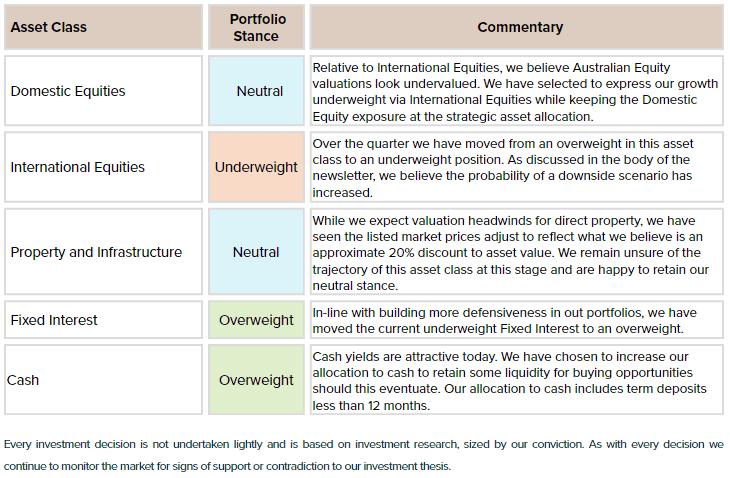
In-line with the outlook, the Investment Committee has decided to move to an underweight growth assets in favour of an overweight to defensive assets. Specifically, we have proposed an underweight position in International Equities to be funded via an overweight position in Fixed Interest and Cash.
Other Portfolio Changes: Move from Janus Henderson Tactical to Core Fixed Interest
In-line with our defensive portfolio stance, a decision has been made to change from the Janus Henderson Tactical Fixed Interest Strategy to Core Fixed Interest for most portfolios. This investment decision represents an increase in interest rate duration and a marginal decrease in credit exposure for active portfolio.
Janus Henderson’s Australian Fixed Interest team remains a quality manager in our view, so we have retained the manager but implemented a change in strategy.
Figure 4: Asset Class Summary and Portfolio Stance
Bottom-up market observations
What to do with the banks
The last four years have been very eventful for bank shareholders, with each year bringing a new set of worries predicted to bring the banks to their knees. 2020 saw capital raisings from NAB and Westpac missing their first dividend since the banking crisis of 1893, as experts forecasted 30% declines in house prices and 12% unemployment! Then 2021 saw the banks grappling with zero interest rates and APRA warning management teams about the systems issues they may face from zero or negative market interest rates, an issue that seems quite comical now. 2022 saw the RBA raise the cash rate from 0.10% to 3.10%, the most rapid tightening ever from Australia's central bank. Now in 2023, the concerns have switched to the impact of sharply rising interest rates on bad debts and the upcoming "fixed rate cliff".
While the banks will surely see rising bad debts over the next year, Allied view that the market is far too negative towards the banks in 2023. Indeed, the main banks are better placed to weather 2023 and 2024 than in 2007 to deal with the last rate tightening cycle.
Bad Debts will rise, but that is not bad
Rising interest rates will see declining discretionary retail spending as more income is directed towards servicing interest costs. While bad debts will increase, this should be expected. In the 2022 financial year, the major banks reported bad debt expenses between 0% and 0.2%, the lowest in history and clearly unsustainable. Excluding the property crash of 1991, bad debt charges through the cycle have averaged 0.3% of gross bank loans for the major banks, with NAB and ANZ reporting higher bad debts than Westpac and CBA due to their greater exposure to corporate lending.
Figure 5: Australian Banking Sector Bad Debts as a Percentage of the Loan Book
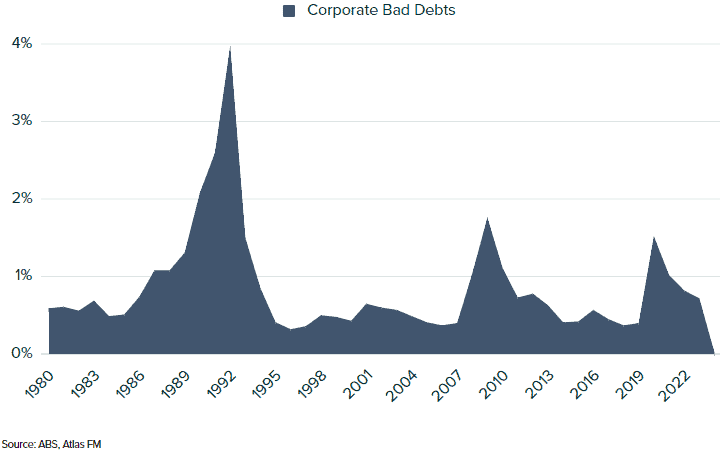
In predicting the trajectory of bad debts in 2024, the 1989-93 spike in bad debts should be excluded, as bank bad debts spiked due to a combination of poor lending practices and very high-interest rates. Indeed in 1991, the head office of Westpac was unaware that different arms of the bank were simultaneously lending to 1980s entrepreneurs such as Bond and Skase et al.
Additionally, during this period, borrowers saw interest rates approaching 20%, a level outside any current forecasts. Today the composition of Australian bank loan books are considerably different to what they were in the early 1990s or even 2007, with fewer corporate loans (such as to ABC Learning, Allco, MFS) and a greater focus on mortgage lending, which is secured against assets and historically has very low loan losses. Additionally, the major banks have pulled the plug on their foreign adventures, with no exposure to northern England and Asia that in 2008 saw high bad debts, often due to the making of questionable loans outside of the core market.
Then and Now
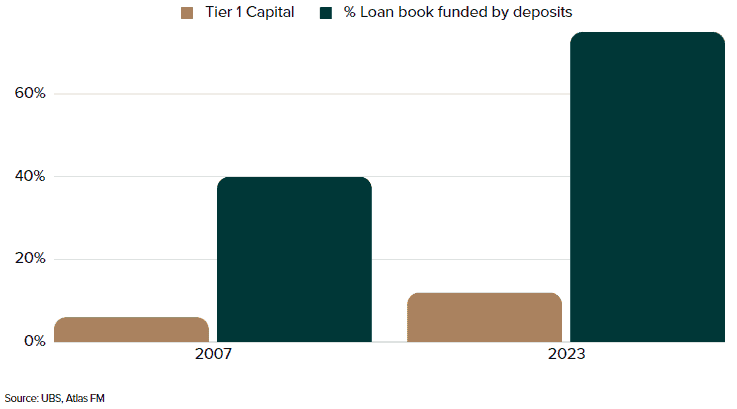
In 2023 all banks have a core Tier 1 capital ratio above the Australian Prudential Regulation Authority (APRA) 'unquestionably strong' benchmark of 10.5%. This allowed Australia's banks to enter the 2022/23 rising rate cycle with a greater ability to withstand an external shock than was present in 2007 going into the GFC, where their Tier 1 Capital ratios were around 6%. For investors, this means that the banks have more capital backing their loans. Additionally, the quality of the loan books of the major banks is higher in 2023 than in 2007 or 1991, which saw a greater weighting to corporate loans with higher loss levels than mortgages. Further, the banks' funding source is more stable today than it was 13 years ago, with an average of 75% of loan books funded internally via customer deposits. This means that the banks rely less on raising capital on the wholesale money markets (typically in the USA and Europe) to fund their lending.
Figure 6: ASX Banking Sector 2007 vs 2023
The major banks face the next few years in a far stronger position than they went into 2007. Currently, the unemployment rate is 3.5%, significantly less than it was going into the last rate tightening cycle. While rising interest rates will undoubtedly cause stress to many borrowers over the next 12 months, so long as employment remains strong, mortgage repayments will remain high and bank bad debts low. However, we expect the outlook for consumer discretionary stocks such as Flight Centre, Harvey Norman and AP Eagers to deteriorate as spending on Bali holidays, televisions and new cars are diverted to service higher mortgage payments.
Figure 7: ASX Banking Sector 2007 vs 2023
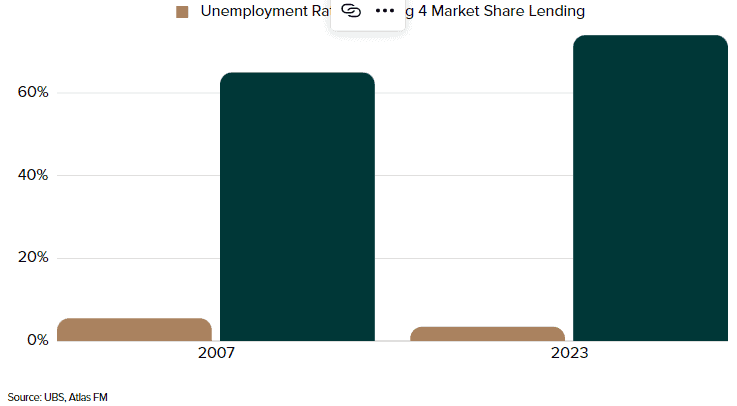
Since the GFC, the banking oligopoly in Australia has only become stronger, with foreign banks such as Citigroup exiting the market and smaller banks such as St George, Bankwest, and now Suncorp being taken over by the major banks. While our political masters bemoan the concentrated banking market structure, having a strong, well-capitalised banking sector looked to be very desirable in March with the collapse of Silicon Valley Bank in the USA and in the wake of UBS' forced takeover of Credit Suisse.
Our Take
Allied Wealth expects the upcoming May reporting season to show that Australia's banks are in good shape and face a better outlook than many sectors of the Australian market. We expect the banks to outperform in the near future, enjoying a tailwind of a rising interest rate environment and high employment levels, which will see customers make the new higher loan repayments. With an average grossed-up yield of +7.2% and lower-than-expected bad debts, bank shareholders will be rewarded for their patience and for ignoring the current market noise.
Yours faithfully,
Allied Wealth Investment Committee
What sets Allied Wealth apart
Allied Wealth's core principles
You are welcome to pass on this commentary or our contact details to anyone whom you think would benefit from our services.

General advice warning
Disclosure
The information provided in and made available through this document does not constitute financial product advice. The information is of general nature only and does not take into account your individual objectives, financial situation or needs. It should not be used, relied upon, or treated as a substitute for specific professional advice.
We recommend that you obtain your own professional advice before making any decision in relation to your particular requirements or circumstances.
Allied Wealth Pty Ltd is a Corporate Authorised Representative of Allied Advice Pty Ltd for financial planning services. AFS Licence No. 528160
Reporting season summary from Atlas Fund Management: Allied Wealth’s preferred direct Australian equity manager
Allied Wealth is pleased to have engaged Atlas Funds Management to provide recommendations for clients who have chosen direct equities for their Australian share component of their portfolio via the Atlas Core Australian Equity Portfolio. We find their income and dividend focus suits our client’s needs well. Reading the reporting season summary from Atlas which follows will also provide an insight to the level of detail and experience that Atlas have to offer.
Key Themes from the February 2023 Reporting Season
The February 2023 company reporting period concluded on 28 February 2023, revealing the financial accounts for the six months ending 31st December 2022. Overall, this was a very mixed reporting season with a greater degree of dispersion than we have seen over the past few years. February showed record profits for several companies while shrinking profit margins, dividend cuts and pessimistic outlooks for others. This was reflected on the scoreboard with the share prices of ASX 200 companies ranging from +25% (GUD) to -33% (Dominos Pizza). This variation in share prices typically occurs every year in February after financial results are reported and contrasts with January and December, where share prices tend to move together, influenced by global macroeconomic events rather than actual corporate profits. The ASX 200 declined by -2.5% in February, mirroring the decline in global markets on fears of falling corporate profits and further rate hikes.
In this piece, we look at the key themes from reporting season, along with the best and worst results and the corporate result of the season.
Mixed Outcomes
Going into the February reporting season, the market was concerned about the impact of higher interest rates and a slowing economy and swung from pessimism in December to an optimistic view that everything would be alright in January. Reporting season showed that both statements were correct; some companies reported excellent results and record profits, showing the resilience of their business models, whereas others cut dividends and provided murky outlooks. Varying corporate profitability reminds investors that when building a portfolio, you are not buying a country or general equities; but rather a share in a collection of businesses that are not impacted by economic events in the same fashion.
While rising interest rates are very negative for highly indebted companies with minimal pricing power, rising rates benefit insurance companies earning investment returns on their insurance float or banks repricing their loan book. Similarly, companies where labour is a high component of the production costs, such as Coles and Woolworths, saw profit margin pressure. In contrast, other companies like Woodside saw minimal impact from rising wages due to the low component labour plays in extracting natural gas from offshore fields.
Higher Costs and Inflation
In February, questions around cost control and the impact of inflation dominated the analyst calls with management. The miners all reported weaker headline results courtesy of the twin issues of falling commodity prices and higher costs. BHP and RIO discussed record diesel prices, high ammonia nitrate prices (explosives), and labour shortages, pointing to higher costs in 2023. Dominos Pizza's share price was under pressure after reporting falling orders in response to raising prices for pizzas and adding a 7% delivery fee.
However, inflation did not impact all companies uniformly in the February reporting season. Packaging company Amcor increased profits and maintained margins after successfully passing on US$1 billion in extra costs to customers from increased resin, plastic films and aluminium prices. Inflation is not much of an issue for toll road owner Transurban. With the bulk of the company's tolls automatically increasing with inflation with a few strokes of a keyboard and the company's debt primarily fixed for the next seven years, rising inflation results in higher profits over the short to medium term.
Woodside saw sharply expanding profit margins in February, with profits up 223%, benefiting from stable production costs (US$8.10 per barrel of oil), highly profitable assets acquired from BHP and rising revenues. A feature of offshore LNG plants is the eye-watering upfront construction costs in the billions but a low ongoing marginal cost of production requiring minimal inputs and labour, giving the company an 85% cash profit margin.
Show me some money, but less than before
One of the starkest themes of reporting season was declining dividends, with the average ASX 200 company reducing dividends by -7%, though as with earnings, the story was mixed with some companies delivering record dividends to their shareholders. The major miners (BHP, RIO and Fortescue) cut their dividends significantly by between 13% and 50% due to falling commodity prices, uncertain outlook, higher future capex and upcoming takeovers. Conversely, February 2023 saw significant dividend increases from Woodside, Newcrest, Commonwealth Bank, Ampol and Whitehaven Coal. However, some Whitehaven investors were disappointed with the +245% increase in the coal company's dividend, citing the low 36% payout ratio. Whitehaven's directors were clearly keen to retain capital after a precipitous fall in the thermal coal price over the past six months. Additionally, coal companies are unwilling to take on bank debt due to concerns that this funding source could be removed in the future.
Unlike the last two reporting seasons, shareholders were not showered with new share buybacks, with only Commonwealth Bank, Qantas, Aristocrat and Amcor announcing significant buybacks.
What lies ahead?
When economies are going through transition periods like what we are currently experiencing, moving from near-zero interest rates and no inflation to rising interest rates, the financial statements from a reporting season can provide a misleading picture of future company profits and dividends. While some companies can pass on rising costs and maintain profit margins, others will see sharp falls in earnings and nervous calls from their bankers. The February 2023 reporting season detailed company profits for the last six months of 2022, which saw both low unemployment and the RBA raise rates from 0.85% to 3.1% in December (currently 3.6%). Due to the rather blunt nature of monetary policy, the full impact of this rate-tightening cycle has yet to be seen on the Australian economy. Retail sales were surprisingly strong, with JB Hi-Fi reporting +9% sales growth over the half, with sales increasing in January 2023. Similarly, Wesfarmers saw 17% sales growth at Kmart, perhaps capturing more price-conscious consumers, and AP Eagers showed continuing demand for new cars.
Best and Worst
Over the month, the best results were delivered by Woodside, Ampol, QBE, Medibank Private, AP Eagers and Flight Centre. The key themes were either very strong profit growth from businesses firing on all cylinders from the first three or companies that outperformed low market expectations in the case of the final three.
Looking at the negative side of the ledger, Downer, Star Entertainment, AMP, Aurizon, and Dominos Pizza fell over the month after reporting earnings below market expectations. The common theme among these was companies having difficulties passing through rising consumer costs. However, in the case of Downer and Star Entertainment, these issues were increased by accounting irregularities and regulatory issues, respectively.
Result of the Season
The most impressive result from the February reporting season came from long-term cellar dweller QBE Insurance. Over the past decade, QBE has provided many surprises on results day, mostly unpleasant, as successive management teams have struggled to manage a very diverse book of global insurance, acquired in an acquisition spree in the first decade of this century.
These acquisitions frequently surprised the market with large losses due to mispriced risk in businesses such as Argentinian worker's compensation, a business line that even close observers of the company were unaware the company had significant exposure to. Over the past few years, the company has consistently divested the problematic parts of the QBE empire.
In February, QBE delivered a clean result with profit up +5.2% to US$847 million, with all segments (Americas, Europe and Asia Pac) benefiting from higher premiums, disciplined underwriting and rising interest rates. Typically, with QBE, investors don't see all three factors simultaneously offering a positive contribution. Conditions are building for a strong 2023 month for the global insurer, as the current tailwinds are likely to persist, particularly higher interest rates.
Our Take
Overall, we were reasonably pleased with the results from this reporting season for the Atlas Core Australian Equity Portfolio. In general, the companies that we own reported improving profits, and indeed, for several companies in the portfolio, February 2023 saw record profits, dividends and new share buyback plans.
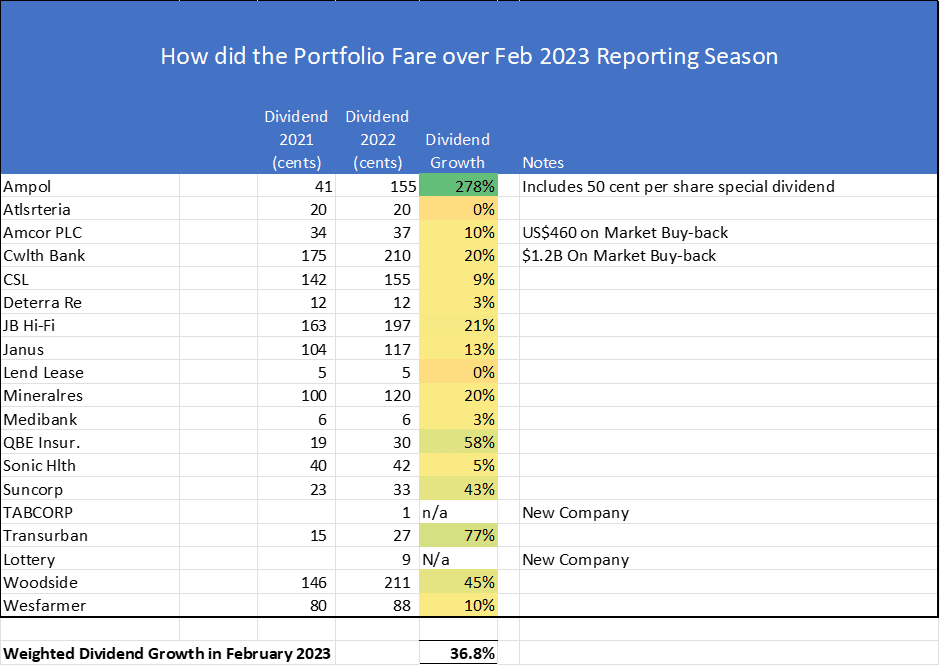
As long-term investors focused on delivering income to investors, we look closely at the dividends paid by the companies we own and, in particular, whether they are growing. After every reporting season, Atlas looks to "weigh" the dividends that our investors will receive from company profits. While share prices move every second between the hours of 10 am and 4 pm, dictated by changing market emotions, ultimately, the sole reason for buying a share is to access a share of that company's profits paid in the form of dividends.
Our view is that talk and guidance from management are often cheap. Also, company CFOs can use accounting tricks to manipulate earnings reported on the Profit and Loss Statement, as Downer EDI's shareholders found out in February. Actually, paying out higher dividends is a far better indicator that a business is performing well and that directors are not concerned about the future.
Using a weighted average across the portfolio, our investors' dividends will be +37% greater than the last six months of 2021. Every company held was profitable and paid a dividend. This result compares very favourably with the broader ASX 200, which saw average dividends fall by -8% in February 2023, led by the large iron ore miners. On this key measure, we are pleased with how the season went.