
"Stocks are claims on the stream of cash that will be delivered to business owners, either in the near-term through liquidation, or over time, as the result of ongoing business activities”. Warren Buffett
Over the past five years, global stock markets have become more volatile, though the volatility has been episodic, driven by macro shocks (inflation, interest rates, oil prices, geopolitical events such as Iran and Greenland) rather than by changes in corporate profits. This results in breathless headlines in the financial press speculating that financial doom is impending and that investors should liquidate their shares to protect their wealth.
While these macroeconomic headlines have seen sharp downward moves in share markets in the moment as investors overreact, their impact usually fades quickly. Avoiding overreaction to macro headlines means not letting every inflation print, oil spike, or central bank comment prompt a change to one’s portfolio. Allied sees that markets are currently hypersensitive to news, but most headlines create short-lived volatility rather than long-term trend changes in most companies' profits or dividends.
During times of market volatility, we find the above quote from the Oracle of Omaha an antidote to headline-driven market reactions because it reminds us that a stock is a fractional claim on a company's future cash flows. The rising influence of index funds on markets adds to volatility: when redemptions rise during times of panic, the fund sells every stock in the market, regardless of its fundamentals or whether it is even affected by the macro worry du jour.
The current conflict with Iran and the closure of the Strait of Hormuz sent share markets tumbling in March 2026, with most global markets falling between 7% and 11%, sending some investors into a panic. However, for most of the companies in our portfolio, the impact of higher energy prices is rather limited, see the table below. The banks may see higher bad debts in the future, and there may be fewer trips on our toll roads, Transurban and Atlas Arteria (though we have yet to see any signs of this). Some companies we own, such as Amcor and Dyno Nobel, have long-term contracts with customers that automatically pass through higher energy prices. Others, such as Mineral Resources and Newmont, will see higher diesel prices increase mining costs, though higher costs have been significantly outweighed by the spike in lithium and gold prices.
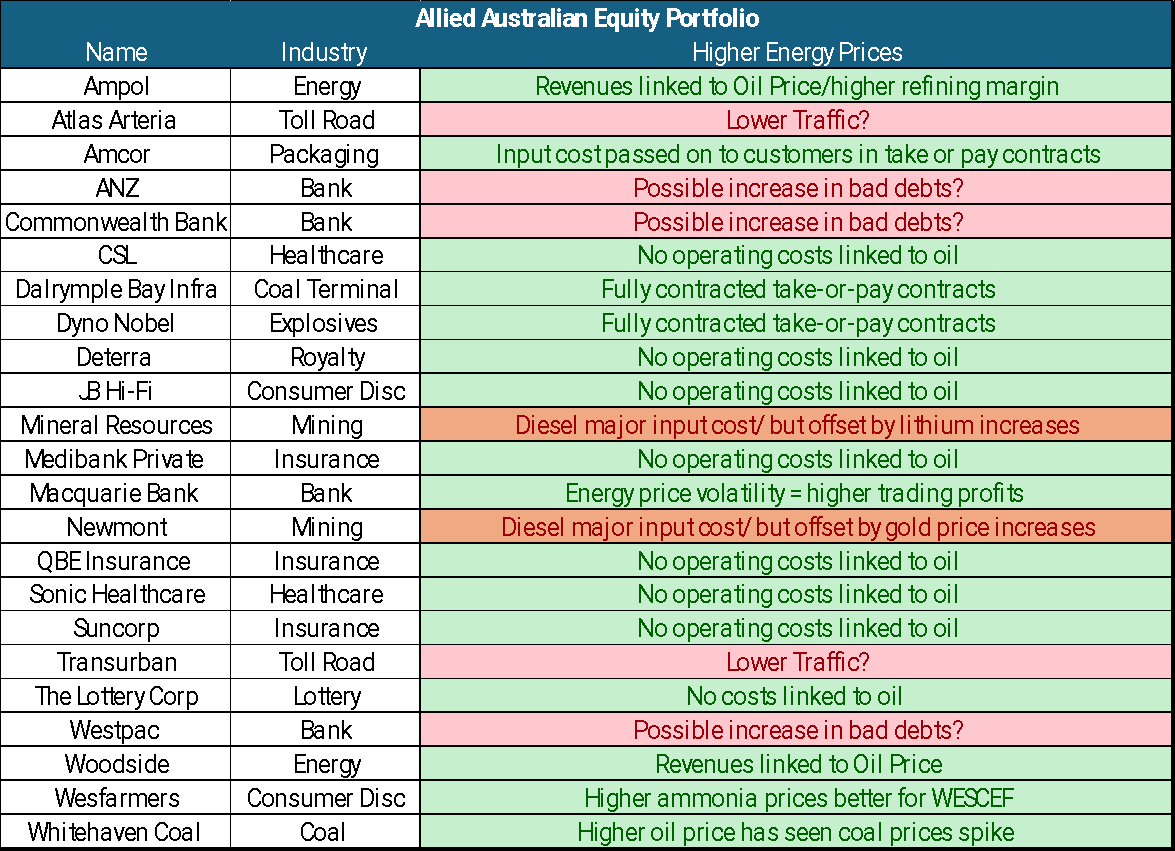
However, for several other stocks in the Allied Portfolio, higher energy prices will lead to higher profits and dividends in 2026. The significant increase in refining margins will be very positive for Ampol; similarly, higher oil prices have boosted demand for electric vehicles, driving lithium prices up 180% and vastly improving Mineral Resources’ profitability. Damage to LNG terminals in Qatar, Saudi Arabia, and Abu Dhabi has seen significantly higher natural gas prices, a positive development for Woodside. Higher natural gas prices have led to a shift in electricity generation from gas-fired power plants to coal. The 50% increase in coal prices improves Whitehaven’s fortunes immeasurably. Further volatility in energy prices contributed to the 30% increase in profit at Macquarie Bank in its 2026 results, released in early May.
Since November 2025, the RBA has been in an interest rate tightening cycle, with rates rising again in May 2026. For many companies, higher interest rates lead to lower profits and dividends as the cost of servicing debt increases. However, in the Allied Australian Equity Portfolio, our process actively targets companies with low levels of gearing. Across the Portfolio, banks traditionally do well in a rising interest rate environment, as they are quick to raise rates for borrowers but slow to increase rates for depositors, with the billions held in transaction accounts at zero rates becoming a very cheap source of funding.
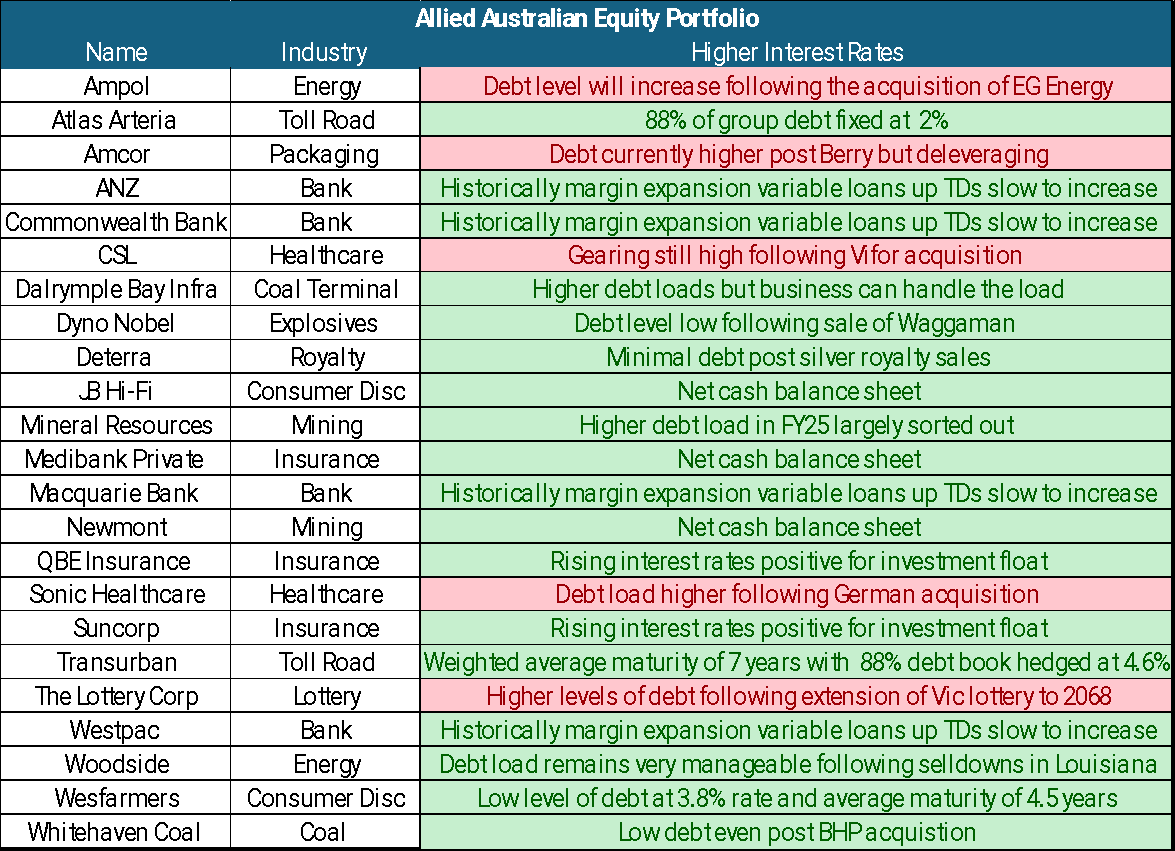
In the table above, in the Portfolio we own a number of companies such as JB Hi-Fi, Medibank Private, Newmont, Deterra and Dyno Nobel that have no debt or a net cash. For these companies, higher interest rates don’t result in any uncomfortable conversations with their bankers.
The insurance companies in the portfolio, such as QBE Insurance, Suncorp and Medibank Private, welcome higher interest rates, providing a tailwind for profits. Insurance is a unique industry where the consumers pay upfront for a service (paying claims) that may be delivered later. This results in insurance companies retaining a “float” of cash held on behalf of their customers, which is constantly being both topped up and paid out, with shareholders benefiting from any returns the company earns on this cash. The size of this float of interest-free money can be quite significant; in QBE's case, it is US$36 billion, so small increases in interest rates can boost profits.
Counterintuitively, two of the more highly geared holdings in the Allied Portfolio, the toll roads Transurban and Atlas Arteria, benefit from higher interest rates. This benefit is due to higher interest rates being associated with higher inflation. Tolls automatically increase with higher inflation; however, both companies took advantage of historically unprecedented near-zero interest rates between 20220 and 2022 to sell long-term bonds. Consequently, higher interest rates result in higher toll revenues, but minimal moves in these companies’ interest costs. Indeed, Transurban revealed that every 1% increase in interest rates translated into an additional $50 million in net profit.
During times of stress in the market, it is important to question whether the crisis du jour will actually impact the companies that you own and whether there will be any change in the near-term dividends that you receive. If the answer is no, then ignore the noise and count your dividend cheques!
Allied Wealth Investment Committee
Allied Wealth's core principles
You are welcome to pass on this commentary or our contact details to anyone whom you think would benefit from our services.
Disclosure
The information provided in and made available through this document does not constitute financial product advice. The information is of general nature only and does not consider your individual objectives, financial situation or needs. It should not be used, relied upon, or treated as a substitute for specific professional advice.
We recommend that you obtain your own professional advice before making any decision in relation to your particular requirements or circumstances.
Allied Wealth Pty Ltd is a Corporate Authorised Representative of Allied Advice Pty Ltd for financial planning services. AFS Licence No. 528160